Generate Rs256 Public Key From Key File
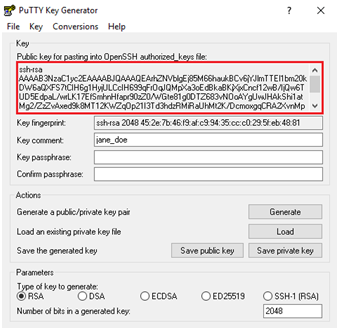
Posted By admin On 15.12.20- Press generate and follow instructions to generate (public/private) key pair. Create a new 'authorizedkeys' file (with Notepad): Copy your public key data from the 'Public key for pasting into OpenSSH authorizedkeys file' section of the PuTTY Key Generator, and paste the key data to the 'authorizedkeys' file.
- So to use public-key signatures, this package needs to be installed: (venv) $ pip install cryptography The next step is to generate a public/private key set (usually called a 'key pair') for the application to use. There are a few different ways to generate RSA keys, but one that I like is to use the ssh-keygen tool from openssh.
Sep 26, 2019 Choose to Import Public Key and paste your SSH key into the Public Key field. In the Key Name field, provide a name for the key. Note: although providing a key name is optional, it is a best practice for ease of managing multiple SSH keys. It will now appear in your table of keys under SSH.
Parses OpenSSL public and private key components and returns a X509Certificate2 with RSA/RSACryptoServiceProvider. (Based on http://www.jensign.com/opensslkey/opensslkey.cs (Archive Link))
| Project | NuGet |
|---|---|
| OpenSSL.PrivateKeyDecoder | |
| OpenSSL.PublicKeyDecoder | |
| OpenSSL.X509Certificate2.Provider |
Support for the following frameworks:
- .NET 2.0
- .NET 3.5
- .NET 4.5 and up
- .NET Standard 1.3 (also NET Core 1.1)
- .NET Standard 2.0 (also NET Core 2.0 and 2.1)
Support for decoding RSA Private Key, Private Key and Public Key.
Example
Generate public certificate + privatekey
Generate public certificate + privatekey using:

Code example 1 - decode private key into RSAParameters
If you just want to decode the private key into RSAParameters, use the following code:
Code example 2 - decode private key into a RSACryptoServiceProvider
If you want to decode the private key into a RSACryptoServiceProvider, use the following code:
Code example 3 - Create a X509 certificate and add private key
Code example 4 - decode openssl RSA public key into RSAParameters
If you just want to decode the rsa public key into RSAParameters, use the following code:
Export the public key from the private key with openssl
How to Generate a Public/Private KeyPair for Use With Solaris Secure Shell
Users must generate a public/private key pair when their site implementshost-based authentication or user public-key authentication. For additionaloptions, see the ssh-keygen(1) manpage.
Before You Begin
Determine from your system administrator if host-based authenticationis configured.
Generate Rs256 Public Key From Key File Download
Start the key generation program.
where -t is the type of algorithm, one of rsa, dsa, or rsa1.
Specify the path to the file that will hold the key.
Bydefault, the file name id_rsa, which represents an RSAv2 key, appears in parentheses. You can select this file by pressing the Return key. Or, you can type an alternative file name.
The file name of the public key is created automatically by appendingthe string .pub to the name of the private key file.
Type a passphrase for using your key.
This passphraseis used for encrypting your private key. A null entry is stronglydiscouraged. Note that the passphrase is not displayed when youtype it in.
Retype the passphrase to confirm it.
Check the results.
Check that the path to the keyfile is correct.
At this point, you have created a public/private key pair.
Choose the appropriate option:
If your administrator has configuredhost-based authentication, you might need to copy the local host's publickey to the remote host.
You can now log in to the remote host.For details, see How to Log In to a Remote Host With Solaris Secure Shell.
Type the command on one line with no backslash.
When you are prompted, supply your login password.
If your site uses user authentication with public keys, populateyour authorized_keys file on the remote host.
Copy your public key to the remote host.
Type thecommand on one line with no backslash.
When you are prompted, supply your login password.
Whenthe file is copied, the message “Key copied” is displayed.
(Optional) Reduce the prompting for passphrases.
For a procedure, see How to Reduce Password Prompts in Solaris Secure Shell. For more information, see the ssh-agent(1) and ssh-add(1) man pages.
C# Jwt Rs256
Example 19–2 Establishing a v1 RSA Key for a User
In the following example, the user cancontact hosts that run v1 of the Solaris Secure Shell protocol. To be authenticated by v1hosts, the user creates a v1 key, then copies the public key portion to theremote host.